

Ever since falling in love with Slay the Spire around 4 years ago, I’ve been trying to find a deckbuilding game that can in some ways live up to it. After popularizing, if not inventing, the roguelike deckbuilding genre, many games have tried to emulate its success. Cobalt Core, a new game developed by Rocket Rat Games and published by Brace Yourself Games of Crypt of the Necrodancer fame, gives me more of what I love and blazes its own path in the roguelike-deckbuilding subgenre.
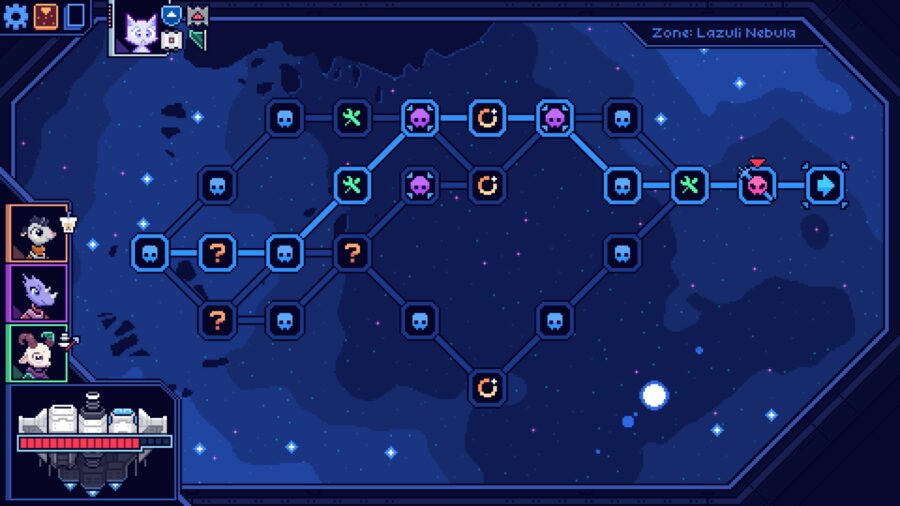
In the gameplay department, fans of Spire or other deckbuilding games will feel entirely at home. When you start a run, you’ll get to choose three pilots to man your ship. These pilots will determine what cards will be available to you throughout your run. Each pilot has their own specialty, ranging from building shield, risky offense, or using drones to do your dirty work for you. Some of these specialties will be familiar to fans of the genre, but others are pretty unique to the genre.

Speaking of “unique to the genre,” Cobalt Core’s ship system is perhaps what makes it feel most fresh. Instead of fighting with a character or party of characters, you fight in ship-vs-ship combat. It seems minute, but this adds more to manage: you can move your ship to dodge attacks, target weak points, or get behind cover. I didn’t know how much of a change this would be, but playing for myself, a surprising amount of depth gets added to the combat from this seemingly-minute change.
Instead of trying to just build up shield, you can use movement cards to dodge out of the way. You could block the attack with a drone. You could use a stun attack to prevent the enemy from acting. There’s a myriad of possibilities, depending on the combination of pilots and ship you choose.
The presentation is just as creative as the gameplay, too. A cute pixel art style is accompanied by a synth-heavy soundtrack. Usually, playing a deckbuilding game is my opportunity to catch up on podcasts or listen through some Spotify playlists. However, I more often than not found myself zoning out to the chill battle themes and humming along in this game instead. It’s easily the most stylized deckbuilders I’ve played in recent memory.
The writing in Cobalt Core complements that presentation well, with a lot of conversations to be had between pilots, your ship’s AI, and the numerous fun NPCs you meet along your journeys. There’s also a bit of a story to the game that, admittedly, I haven’t found the time to see to its end. However, as you complete cycles and learn more about the mysterious time loop and titular Cobalt Core, it seems like there’s some interesting things to learn. The story & writing probably won’t be the main attraction that keeps you coming back, but cute banter between your crewmates is a fun extra cherry on top of some of the incredibly fun package.
Overall, after roughly 15 hours of playtime, Cobalt Core stands out in a crowded year as one of my favorites, evoking things I love about roguelikes and giving me new features to appreciate, too. If you love Slay the Spire, play Cobalt Core. If you like roguelikes, play Cobalt Core. If you’re a fan of cute animals, play Cobalt Core. Really, you should just play Cobalt Core. It’s out on Nintendo Switch & Steam right now, and it’s perfect for portable play.
A Steam code for review was provided by Brace Yourself Games.




















 Of course, this is the first thing you ought to do. While this is a quick fix to economic woes, you need to balance it out by ramping up the tax rate over a few months, rather than in one fell swoop. This is a careful balancing act as it can lead to unforeseen problems such as a mass exodus of businesses and residents, as well as widespread destitution and homelessness. Higher taxes should be a very short term fix to a negative monthly city revenue, and you should pivot to other solutions as soon as possible.
 Found under the Services tab, in the Economy menu, the budgets for every city service from Roads to Landscaping can be individually tweaked. While you can cut down heavily on expenses by reducing the budget for a given service, be aware that doing so leads to employee redundancy which in turn lowers that particular service’s performance or quality over a period of several months, which should give you some breathing room in the short term, but cannot be sustained over the long term without damaging Cim satisfaction with your city.
 That tried and true tactic, just like in real life, parking fee income should especially be your go to as of right now during the launch of the game, because you can comfortably impose the highest possible fee of $50 currently without any repercussions from Cims. Whether it is intentional design or simply a bug, doesn’t matter, but this applies to both roadside parking and lots.
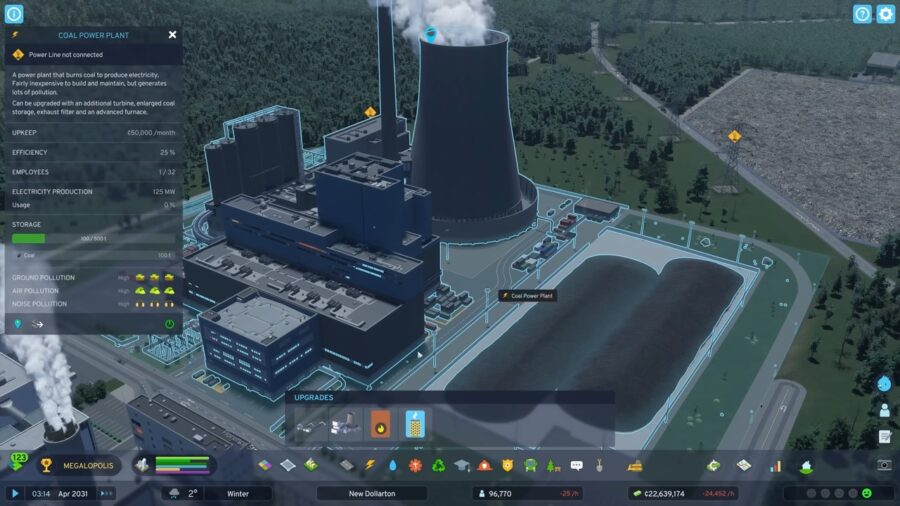 Cities run on the two most basic of needs–electricity and water, and if you have them in excess, some city somewhere else could do with their supply. Early on, Coal and Wind sources will suffice for generating electricity for export, but maximum efficiency for your operating costs will be achieved with a Geothermal Power Plant. Once you’ve set up the grid connections, funds will just trickle in with no further effort from you.